


 Osa Commerce

Unlock the power of unified commerce to accelerate inventory turns, reduce stockouts, and drive operational excellence in modern logistics networks.
Transforming Inventory Management with Unified Commerce
Unified commerce usually gets framed around front-end convenience: buy online, pick up in-store, endless aisle, unified cart, unified profile. These are indeed important. But the real financial impact lies behind the scenes: higher inventory turns and lower working capital.
Unified commerce fundamentally redefines inventory management by breaking down barriers across channels, systems, and data silos. Through a single, collaborative visibility and unified platform, such as the Osa Unified Commerce Platform, businesses can aggregate inventory information from warehouses, stores, marketplaces, and fulfillment partners into a single view.
This transformation empowers organizations to leverage real-time data to improve forecasting accuracy, reduce discrepancies, and minimize excess safety stock. By connecting every node of the supply chain, unified commerce ensures that inventory is optimally positioned to meet demand and reduce friction from manual reconciliation and fragmented operations.
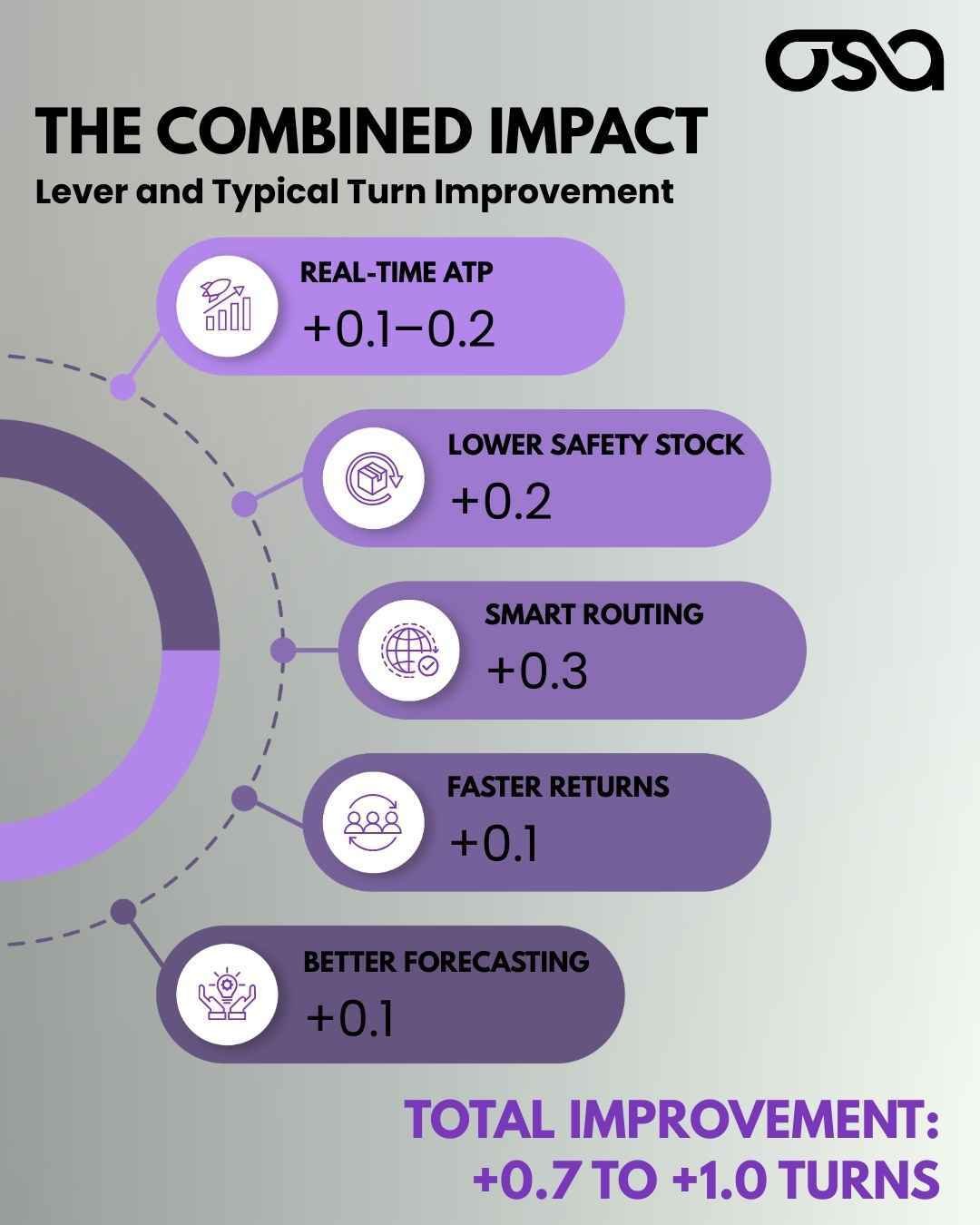
Here’s a practical look at how unified commerce drives higher turns, with real numbers and simpler math.
1. Real-Time Inventory Accuracy Boosts Sell-Through
Most brands still run inventory in silos. Stores see one picture. Shopify sees another. Marketplaces see their own. Third-party logistics ( 3PLs) usually have the most accurate view—but the slowest sync cycles.
Even with integrations, inventory updates lag minutes or hours.
That delay creates invisible inventory—units you physically have but can’t legally sell.
With Unified Commerce
Even if only 150 of the hidden units become sellable online:
150 × $80 = $12,000 in freed inventory
Turns rebound from 4.0 → ~4.2
No demand change. No discounting. Just better accuracy.
Unified commerce makes existing stock visible—and therefore liquid.

2. Shared Inventory Pools Reduce Safety Stock
Disconnected channels force brands to carry safety stock everywhere:
- Stores keep their cushion.
- DTC keeps its cushion.
- Marketplaces hold theirs.
- 3PLs buffer heavily to avoid stockouts and penalties.
This redundancy is expensive—and completely unnecessary with a unified view.
Unified commerce pools the demand signal and lets you calculate safety stock at the network level—not the node level.

3. Real-Time Data Synchronization to Eliminate Stock Inaccuracies
Real-time data synchronization is at the core of unified commerce, enabling unparalleled accuracy in inventory counts across all channels. With continuous, automated updates from warehouse management systems (WMS), order management systems (OMS), and integration hubs, businesses eliminate the risk of overselling, stockouts, and lost sales due to inaccurate inventory data.
This level of synchronization enhances sell-through rates by ensuring that each sales channel reflects true inventory availability. It also drives operational agility, allowing supply chain teams to respond instantly to demand shifts and improve working capital efficiency.
4. Orchestrating Faster Return-to-Available Cycles
Returns can be the biggest drag on inventory velocity. Without unified workflows, items sit in “QA,” “in transit,” or “processing” longer than they should. Unified commerce platforms log, triage, and re-list returns in near real time.
By treating inventory as a shared pool accessible to all channels, organizations can reduce the need for excessive safety stock, decrease cycle times. This orchestration not only improves inventory velocity but also enhances customer satisfaction through faster delivery and greater product availability.
5. Leveraging Predictive Analytics and AI for Optimized Replenishment
Advanced predictive analytics and AI-driven demand forecasting are integral to unified commerce strategies. By analyzing historical data, market trends, and real-time demand signals, AI models can recommend optimal replenishment cycles, highlight slow-moving stock, and anticipate surges in demand before they occur.
These insights drive smarter inventory decisions at every level of the supply chain, reducing overstocking and markdown risk while ensuring high-demand items are always available. AI-powered optimization translates directly into higher inventory turns, improved margins, and a more resilient supply chain.
Integrating WMS, OMS, and Fulfillment for End-to-End Visibility
Unified commerce isn’t just a customer experience strategy.
It’s a supply chain performance strategy.
When you connect stores, marketplaces, ERPs, WMS, OMS, and 3PLs into one real-time system:
- Inventory becomes one shared pool
- Routing becomes intelligent
- Safety stock shrinks
- Sell-through rises
- Working capital unlocks
- Turns accelerate—consistently
The math is simple once the data foundation is right.
This is exactly what unified platforms like Osa Commerce are built to deliver: a single source of inventory truth that helps brands and 3PLs sell more with less, move faster, and operate like one connected network—not a fragmented one.
