


7 min read
In this guide
Key Takeaways
- Adobe forecasts $15.1 billion in U.S. online spend on Cyber Monday 2026 (November 30), up 6.2% year over year.
- Peak demand now starts in October, so inventory and carrier capacity need to be ready weeks before Cyber Monday.
- Unified inventory and order data across every channel helps brands and 3PLs prevent stockouts when order volumes spike.
- Collaboration with 3PLs and suppliers should extend past Cyber Monday into post-holiday returns and restocking.
- Treat peak season planning as a year-round discipline so the systems built for Cyber Monday keep paying off after the holidays.
Cyber Monday decides whether peak demand turns into revenue or into stockouts and late deliveries. Here is how you and your 3PL partners can prepare for the biggest online shopping day of 2026 and the longer peak season around it.
In this guide
The High Stakes of Cyber Monday Logistics
Cyber Monday exposes every crack in your supply chain. It tests your inventory precision, stresses every fulfillment partner, and separates true omnichannel leaders from the rest.
Adobe's 2026 holiday shopping forecast expects U.S. shoppers to spend $15.1 billion online on Cyber Monday (November 30), up 6.2% year over year, keeping it the biggest online shopping day of the season. Adobe projects the full Cyber Week will drive $47.5 billion online. You need more than hype and discounts. You need flawless execution across your entire supply chain.
During peak season, you and your third-party logistics (3PL) partners need agile, unified supply chain management, because order volumes climb far above a normal week and stay high through Cyber Week.
Shoppers expect consistent omnichannel experiences and rapid delivery with real-time order visibility. Any breakdown, such as a stockout or a shipment delayed by a disconnected system, costs you revenue and brand loyalty.
Building a Resilient and Agile Supply Chain
Resilience and agility win Cyber Monday. Forecast demand early, diversify your suppliers, and back both with contingency plans, so your operation can absorb disruptions and pivot quickly.
That takes end-to-end collaborative visibility and unified supply chain management.
A Unified Commerce approach that connects warehouse and order management with fulfillment lets organizations synchronize inventory across sales channels and reduce vulnerabilities. Brands can work with suppliers and logistics partners, using multi-node or fourth-party logistics (4PL) fulfillment networks to add flexibility and limit stockouts or delivery delays. In NTT DATA and Penn State's 2025 Third-Party Logistics Study, 87% of surveyed shippers reported increasing their use of outsourced logistics.
To map every step from inventory positioning to post-holiday returns, work through our ecommerce peak season checklist.
Why Cyber Monday Demands Peak Performance
Without preparation, you get left behind. Cyber Monday keeps reshaping retail, with digital-first shopping becoming the norm and operational complexity rising at every turn.
Here’s what’s driving the stakes higher:

Mobile Takeover
Mobile is now the default checkout. Adobe expects mobile devices to drive 57.4% of U.S. online holiday spend in 2026, up from 56.4% in 2025. Every one of those taps depends on inventory data that is accurate the moment the shopper hits buy.
AI and Website Traffic
Shoppers are using AI chat and browser tools to find deals, and Adobe expects AI-driven traffic to U.S. retail sites to rise 130% year over year this holiday season, with Cyber Monday up 88%. This is a great way to capture intent. But it could be a potential disaster if back-end systems can’t keep up or you don't have a secure system to store customer data.
Omnichannel Expectations
Customer expectations have leapfrogged. In the 2025 holiday season, nearly one in five orders used BOPIS (Buy Online, Pick Up In-Store), according to Salesforce holiday shopping data. Adobe's 2025 holiday season recap found curbside pickup made up 17.1% of U.S. online orders at retailers offering it. Offering them only works when store inventory counts are accurate in real time.
An Earlier, Longer Peak Season
Peak demand no longer waits for Thanksgiving. Adobe expects $95.8 billion in U.S. online spend in October 2026, up 8% year over year, including $9.9 billion during the October 6–7 Prime Day event. That pre-season spike means inventory and carrier capacity need to be in place weeks before Cyber Monday, with labor plans ready to flex. We cover the planning shift in our guide to an earlier peak season.

The Hidden Enemy: Supply Chain Data Chaos
Siloed systems create data chaos. Sharing data across your ecosystem matters every day, and during peak buying seasons it is a necessity.
Cyber Monday's order spike amplifies the operational risks that retailers and 3PLs battle all year, only now in real time, with millions of impatient shoppers watching.
Without systems like the Osa Unified Commerce Platform, retailers may be facing:
Inventory Challenges
Demand also shifts in ways last year's forecast can miss. Adobe expects Cyber Week online sales of clothing basics to rise 210% and personal hygiene products to rise 150% compared with September 2026 averages. And don't forget about stockouts. They’re brand killers, often driving shoppers directly to competitors.
Fulfillment Bottlenecks
Shoppers expect fast shipping, but 3PLs can't perform magic without accurate forecasting and visibility. Without integrated systems, "estimated delivery" turns into "never arrived" far too often, and every missed delivery costs revenue.
Supplier Coordination
Supply chain leaders are responding by shoring up their supplier networks. In McKinsey's 2024 supply chain risk survey of 88 global executives across industries, 73% reported progress on dual sourcing. But without centralized visibility, this introduces operational noise instead of clarity. By integrating systems and unifying data, Osa is helping brand and retail customers connect everything from their Product Lifecycle Management (PLM) and Order Management Systems (OMS) for faster fulfillment and time to market.
Use Technology for Real-Time Orchestration
Collaborative technology is at the heart of modern supply chain orchestration. Real-time inventory tracking and order management, paired with analytics, help organizations spot bottlenecks and balance workloads before labor runs short during peak periods. Unified Commerce Platforms deliver end-to-end visibility and AI-driven forecasting, enabling data-driven decisions that improve order accuracy and speed.
The future requires automated workflows and advanced analytics, connected through reliable API integrations, so operations scale as order complexity rises.
Real-Time Inventory Visibility
AI-powered inventory tracking gives brands and 3PLs a shared, real-time view of what is available and where it sits, so teams know how fast it can move. That matters most when more than half of holiday online spend comes from mobile shoppers ready to convert in seconds.
Predictive Demand Forecasting
Demand forecasting fueled by AI and machine learning matches inventory to real consumer behavior instead of guesses. It is what lets businesses staff up and stock right, so they avoid the panic of out-of-stock notices mid-sale.
Omnichannel Fulfillment Built to Flex
True omnichannel orchestration means fulfilling orders however customers place them (direct-to-consumer, in-store pickup, drop shipping, or marketplace fulfillment) through a single, unified platform.
Collaborative Partner Ecosystems
Cyber Monday success requires lockstep coordination between brands and every 3PL and supplier in their network. Connected systems replace frantic calls and reactive decisions with proactive planning.
Collaborative Strategies for Peak Season Readiness
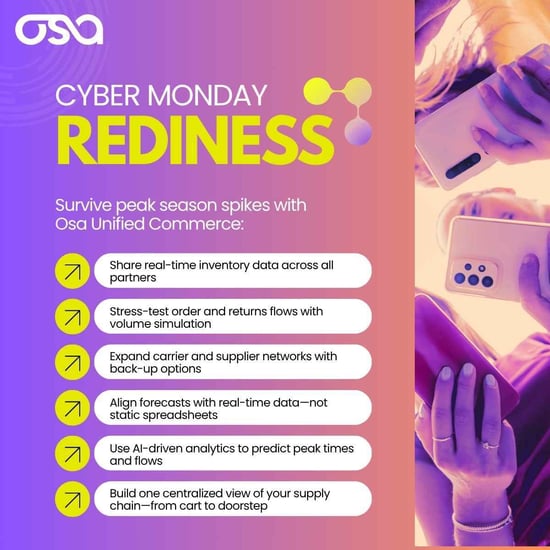
Cyber Monday success takes collaboration. Work across functions inside your company and across your extended supply chain. Line up backup suppliers with your 3PL partners and share real-time data to manage uncertainty and limit disruptions.
Unified platforms let you plan and execute together, so you can align inventory and staffing with logistics capacity. AI-powered platforms and predictive analytics support proactive customer engagement and demand management. They cut your risk of overselling and understocking and keep the customer experience consistent across channels.
Collaboration has to extend past Cyber Monday, too. In NRF and Happy Returns' 2025 holiday returns survey, e-commerce professionals at large U.S. merchants expected 17% of holiday sales to be returned.
Agree on returns processing and restocking rules with your 3PL before peak starts. Our best practices for reducing returns show how to keep that volume from eroding holiday margins.
Plan for Cyber Monday All Year
Don't treat peak season as a one-off. The strategies and technologies you deploy for peak can drive value year-round. Continuous investment in unified commerce platforms and automation, backed by advanced analytics, builds a resilient, scalable foundation that extends beyond the holiday rush.
Brands that stand out on Cyber Monday plan for the surge like an everyday requirement, because in many ways it is. Shoppers expect a consistent experience year-round, and winning their loyalty takes an operational engine built for agility and clarity.
Master supply chain orchestration and you maximize Cyber Monday performance, then carry that agility and profit into the rest of the year. The lessons you learn and the systems you tune during peak position you to compete in a dynamic market.
Let Osa Commerce guide your journey for peak season and beyond.
Reach out to learn how Osa Commerce can help
Cyber Monday Supply Chain FAQs
Answers for teams planning for Cyber Monday.
How Far in Advance Should Retailers Start Planning Cyber Monday Supply Chain Operations?
Start in summer. Osa recommends planning holiday inventory by July. In our experience working with ecommerce brands and 3PLs, waiting until October is too late. Adobe expects $95.8 billion in U.S. online spend in October 2026, so stock and carrier capacity need to be in place before that pre-season spike, well ahead of Cyber Monday.
How Much Will Consumers Spend on Cyber Monday 2026?
Adobe expects U.S. shoppers to spend $15.1 billion online on Cyber Monday (November 30, 2026), up 6.2% year over year. That keeps Cyber Monday the biggest online shopping day of the season. Adobe also projects the full Cyber Week will drive $47.5 billion online, up 7.4% year over year.
How Can Retailers Avoid Stockouts on Cyber Monday?
Give every channel and partner the same real-time view of inventory, then use AI forecasting to match stock to real shopper behavior. Osa Order Management supports this with real-time inventory synchronization across channels and warehouses, plus inventory alerts and automated replenishment triggers that flag low stock before a sale runs dry.
How Do I Handle Shipping and Carriers on Cyber Monday?
Lock in carrier capacity and cutoffs before the surge. For Dec. 25 delivery in the lower 48, USPS recommends send-by dates of Dec. 17 for Ground Advantage and Dec. 18 for Priority Mail, and FedEx and UPS add peak surcharges that start in late October. Set your warehouse cutoff earlier than any carrier date, then route each order to the carrier that still makes the deadline. For the full 2026 dates and fees, read our holiday fulfillment guide.
How Do I Prepare My Warehouse and Fulfillment for Cyber Monday?
Start weeks ahead, because Adobe expects $95.8 billion in U.S. online spend in October 2026, before Cyber Monday arrives. Give your warehouse, 3PLs and suppliers the same real-time view of inventory and orders, so bottlenecks show up before labor runs short. Agree on returns processing and restocking rules with your 3PL before peak starts.
How Do I Manage Customer Communication During Cyber Monday?
Get ahead of the "where is my order" question. Send proactive shipment status updates and delay alerts, and give customers a real-time tracking view they can check on their own. Osa Last Mile Management provides real-time delivery progress and predictive AI/ML alerts, so your team can flag delays before customers have to call.