What is Unified Commerce?
A Guide for 3PLs and Brands
Managing a complex supply chain has become increasingly challenging. Traditional, siloed systems are no longer enough to keep up with the demands of modern consumers and the ever-evolving business landscape.
That's where Unified Commerce comes in — a transformative approach to supply chain management that is redefining the way 3PLs and brands operate.
The Future is Connected
Why 3PLs and Brands are Racing to Unified Commerce
Let’s be real for a second: the modern supply chain is a bit of a circus. Between managing TikTok Shop orders, keeping an eye on Amazon FBA, and making sure your brick-and-mortar shelves aren't gathering dust, it's enough to make any logistics manager’s head spin. For years, we’ve been told that "Omnichannel" was the holy grail. But as many third-party logistics (3PLs) and brands have discovered the hard way, having a presence everywhere doesn't mean a thing if your systems aren't actually talking to each other.
Enter Unified Commerce. It’s not just a fancy buzzword to toss around at board meetings; it’s a fundamental architectural shift. While omnichannel was about being everywhere for the customer, Unified Commerce is about being one for the business.
Below, we will explore what unified commerce is, who uses it, why, and the benefits. Buckle up, because the old way of doing business is officially "so last year."
What Is Unified Commerce Exactly?
Everything in One Place
At its core, Unified Commerce is a comprehensive strategy that seamlessly integrates all sales channels, touchpoints, and backend systems into a single platform.
Within supply chain management for 3PLs or omnichannel brands and retailers, unified commerce offers an end-to-end approach to managing the entire supply chain ecosystem via data centralization. Unlike traditional siloed systems, a Unified Commerce Platform (UCP) connects, unifies, and optimizes all components and processes across a supply chain, from inventory management and order fulfillment to transportation logistics and customer experience.
Key aspects of unified commerce for supply chains include:
-
Centralized Operations: A single view of sales channels, order sources, product data, inventory, and fulfillment capabilities into one centralized system.
-
Single Source of Truth: Every transaction, channel, and piece of data lives in a unified architecture, eliminating operational silos and data discrepancies.
-
End-to-End Integration: Connects front-end, customer-facing storefronts directly with back-end logistics and supply chain systems.
-
Consistent Fulfillment: Combines all retail and supply chain systems to ensure an agile, accurate, and consistent experience from the moment an order is placed to final delivery.
For growing supply chain businesses, this means that an order placed on Instagram is visible to the warehouse floor the second the "Buy" button is clicked. No lag. No manual data entry. No "oops, we actually sold that last pair of sneakers five minutes ago" emails to disappointed customers.
Omnichannel vs. Unified Commerce
The Great Debate
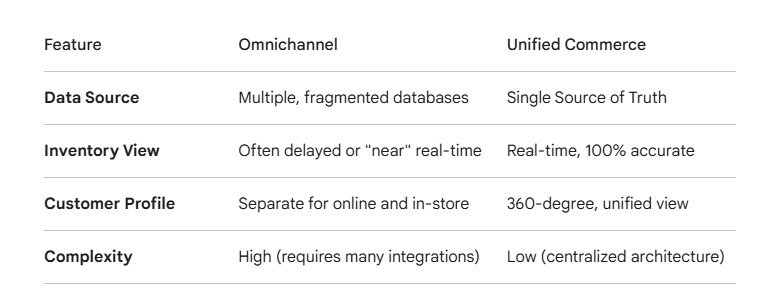
You might be thinking, "Wait, isn't this just Omnichannel?" Not exactly! While they share a common goal, to make customers happy, omnichannel is still a "multi-channel" approach.
Omnichannel commerce focuses on providing a seamless, consistent customer experience across multiple sales channels, such as in-store, online, and mobile. While omnichannel is a critical component of modern retail and supply chain management, Unified Commerce takes it a step further by integrating and optimizing all backend operations and data that support customer-facing channels.
Unified Commerce Platforms offer true operational synchronization from procurement to delivery. Every channel—online, offline, social, marketplace—feeds into the database in real time.
How Does Unified Commerce Work?
Smart Engineering Magic
Unified Commerce links disconnected data and systems—such as inventory, order management, and customer data—into one centralized backend architecture. It sounds like magic, but it's actually just smart engineering.
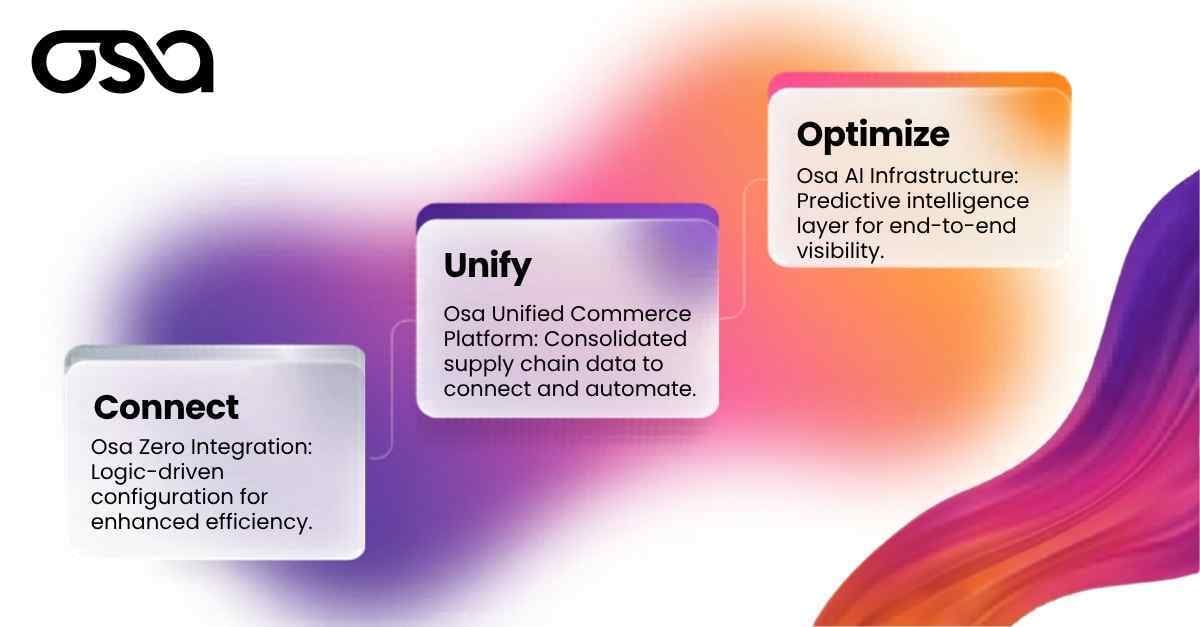
Specifically, a Unified Commerce Platform acts as a "bridge," collapsing the distance between demand and supply by connecting disparate systems, data sources, and stakeholders into a cohesive, interconnected ecosystem.
Key capabilities of a Unified Commerce Platform include:
-
Connectivity: Integrate supply chain systems, from Warehouse Management Systems (WMS) to transportation to e-commerce, to enable real-time data sharing and visibility.
-
Unification: Consolidate data, processes, and decision-making into a single, centralized platform to eliminate silos.
-
Optimization: Leverage advanced analytics and AI to identify and address inefficiencies across inventory, fulfillment, logistics, and more.
-
Agility and Scalability: Provide a flexible, cloud-based infrastructure that can adapt to changing business needs and market conditions.
By centralizing logic, you eliminate the "data silos" that cause friction in your daily operations. Unified Commerce Platforms empower businesses to achieve greater efficiency, agility, and customer-centricity in their supply chain operations.
Who Uses Unified Commerce?
And How?
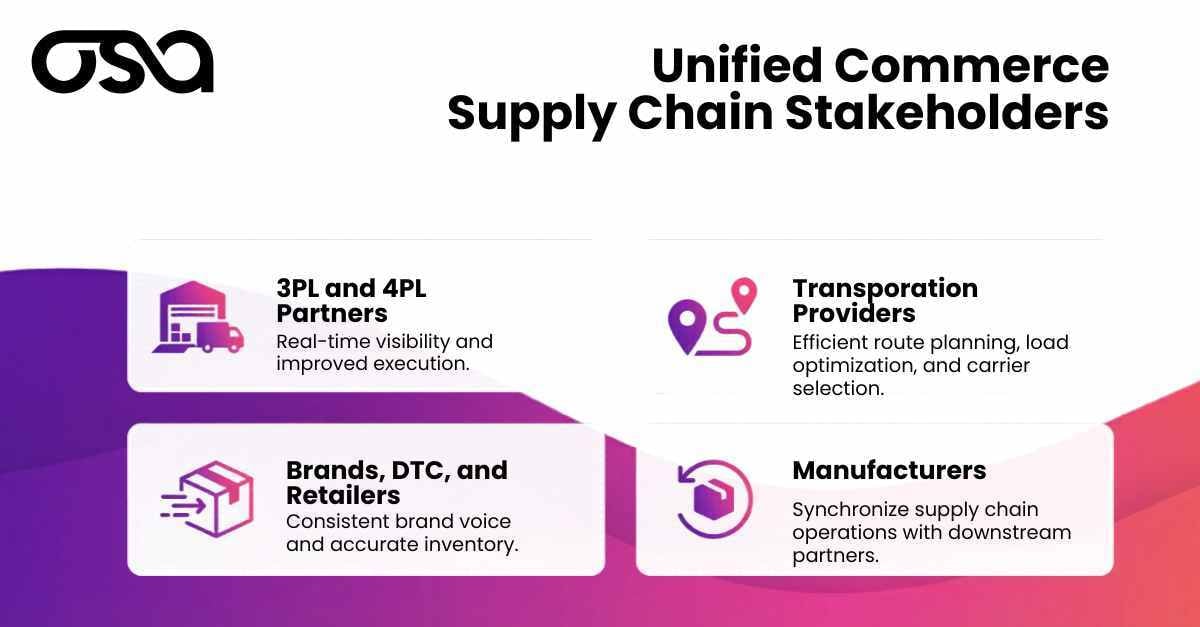
Unified Commerce Platforms are primarily used by two key stakeholders in the supply chain ecosystem: Third-Party Logistics (3PLs) Providers and Brands. AI and cloud-based unified commerce platforms help organizations manage complex supply chains more effectively and optimize omnichannel operations. Yet almost every stakeholder benefits from integrated, collaborative technology.
Here is how different supply chain stakeholders use Unified Commerce Platforms:
-
Progressive 3PLs & 4PLs: Logistics providers are no longer just "box movers"— but strategic technology partners. By using Unified Commerce, 3PLs can offer brand clients real-time visibility, while 4PLs can focus on execution.
-
Manage complex, multi-client, and multi-partner supply chains more efficiently.
-
Ability to integrate various systems, data sources, and processes across operations, providing end-to-end visibility and optimization.
-
Streamline inventory management, order fulfillment, transportation logistics, and other key functions into a singular view.
-
Leverage advanced analytics and AI capabilities to identify and address inefficiencies, improving overall supply chain performance.
-
Brands, Direct-to-Consumer (DTC), and Retailers: Unified Commerce is a lifesaver for many wholesale or pop-up brands. It offers a consistent brand voice and accurate inventory for scale. Retailers get a unified view of inventory in real-time to manage "Buy Online, Pick Up In-Store" (BOPIS) or "Ship from Store" options.
-
Optimize omnichannel operations and enhance the customer experience.
-
Unify data and processes across all sales channels, from e-commerce and brick-and-mortar to mobile and social media.
-
Gain a holistic view of inventory, orders, and customer behavior, allowing them to make more informed, data-driven decisions.
-
Improve inventory management, order orchestration, and fulfillment to ensure they meet customer demand across all touchpoints.
-
Manufacturers: Unified commerce provides a strategic framework to integrate inventory, order management, and production systems to eliminate operational inefficiencies and reduce costs.
-
Better integrate and synchronize supply chain operations with downstream partners (3PLs, brands, retailers).
-
Gain real-time visibility into demand patterns, inventory levels, and order fulfillment, allowing optimized production planning and scheduling.
-
By connecting with logistics providers and customers through a UCP, manufacturers can enhance supply chain collaboration and responsiveness to changing market conditions.
-
Transportation Providers: From pre-planned flows to network-order optimization, Unified Commerce Platforms transform Transportation and Carriers into strategic partners rather than mere delivery services.
-
Carriers and freight forwarders optimize their logistics operations and improve service delivery.
-
Integrate transportation data with inventory, order, and customer information to enable more efficient route planning, load optimization, and carrier selection.
-
Access to advanced analytics and predictive capabilities to anticipate and respond to disruptions, such as weather events or traffic congestion.
-
Improve on-time delivery, reduce costs, and enhance the overall customer experience.
By integrating diverse supply chain stakeholders and functions, Unified Commerce Platforms create a cohesive, data-driven ecosystem that enables greater collaboration, optimization, and responsiveness across the entire supply chain.
What are the Advantages of Unified Commerce?
Core Benefits of a Frictionless Journey
Moving to a unified model isn't just about making your supply chain "cleaner"—it's about making it more profitable.
By integrating the various components of the supply chain, Unified Commerce Platforms deliver a range of advantages—including enhanced visibility, improved inventory management, optimized logistics, streamlined customer experiences, and increased agility. Combined, these benefits reduce operational costs.
-
Goodbye, Out-of-Stocks: Increase inventory accuracy and stop carrying massive amounts of "safety stock" just in case data is wrong. This unlocks working capital you can actually use.
-
Faster Fulfillment: Streamline fulfillment and know exactly where every item is. Orders get routed to the closest location. Faster shipping = happier customers.
-
Better Customer Retention: Earn "fanatical" loyalty with access to the entire product journey — in-store returns, online complaints, and loyalty points—all in one screen.
-
Reduced IT Costs: Simplify system efficiency and maintain data in a single platform instead of different integrations.
Overall, Unified Commerce Platforms offer highly accurate data, reduced operational costs, streamlined inventory management, and a frictionless customer journey.
How is Artificial Intelligence (AI) Transforming Unified Commerce?
Predictive Supply Chain
Artificial Intelligence (AI) is the rocket fuel for Unified Commerce. It’s moving from "nice-to-have" to "can't-live-without."
AI isn't just about chatbots. It's about Predictive Inventory. AI and Unified Commerce Platforms enhanced demand forecasting capabilities.
Here's how AI contributes to more accurate and reliable demand forecasting:
-
Analyzing Historical Data: AI-powered algorithms can sift through vast amounts of historical sales data, inventory records, and other relevant information to identify patterns, trends, and correlations, helping to better understand the factors driving demand for specific products or services.
-
Incorporating External Factors: AI models analyze a wide range of external data sources, including economic indicators, market trends, social media sentiment, and weather patterns, to more accurately predict shifts in customer behavior and market conditions.
-
Real-Time Demand Sensing: AI-enabled demand sensing can continuously monitor data across touchpoints, including e-commerce platforms, point-of-sale systems, and social media, enabling more agile and responsive supply chain planning.
-
Predictive Analytics: AI algorithms can leverage advanced techniques to forecast future demand, drawing on historical data and external factors to identify subtle patterns and interdependencies that may be difficult for human analysts to discern.
-
Continuous Learning and Adaptation: AI-powered demand forecasting models are designed to learn and improve over time, incorporating feedback from actual sales data and market conditions, to improve the accuracy and reliability of demand forecasts.
-
Scenario Planning and Simulation: AI can run multiple demand-forecasting scenarios to simulate the impact of factors such as promotions, new product launches, or supply chain disruptions, to help supply chain managers better prepare contingency plans and mitigate risks.
Furthermore, AI is enabling "Agentic Commerce" to handle routine procurement or re-ordering tasks autonomously. Imagine a supply chain that fixes its own bottlenecks before you even know they exist! That's the power of AI in a unified environment.
Why Implement Unified Commerce?
Osa Unified Commerce Platform
There are plenty of tools out there that feature "Unified Commerce" capabilities—claiming to be unified but are just older systems with better APIs.
Modern Unified Commerce Platforms are built to consolidate supply chain systems, help navigate complex orchestration with unparalleled agility and accuracy, and leverage data-driven insights to scale effectively.
The Osa Unified Commerce Platform is designed to help 3PLs and brands overcome the challenges of modern supply chain management and unlock the full potential of their operations. With Osa Commerce, you'll gain seamless connectivity, a centralized platform, advanced analytics and optimization, unparalleled agility, and improved customer experience — all of which can transform your supply chain into a strategic competitive advantage.
Here’s why it’s a cut above:
-
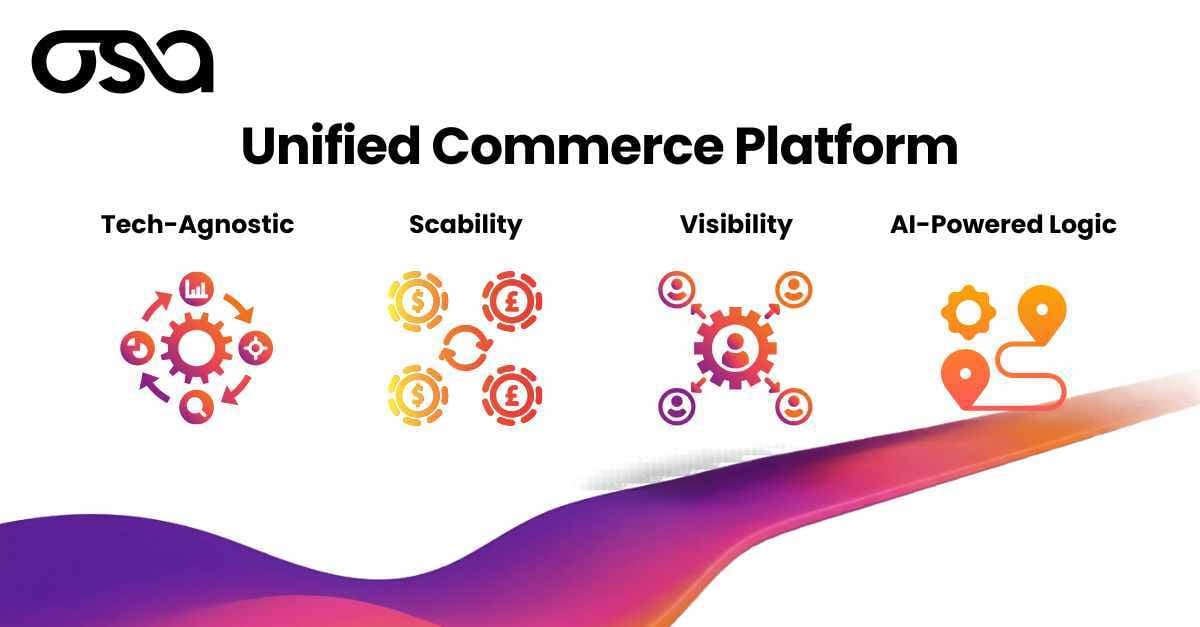
Tech-Agnostic: Easily integrate with existing ERP, WMS, and TMS. No need to rip and replace everything.
-
Scalability: Whether you’re shipping 1,000 orders or 1,000,000, the infrastructure grows with you.
-
Unrivaled Visibility: We’re talking "down to the SKU" transparency across every warehouse and retail node.
-
AI-Powered Logic: We use AI to optimize your order routing, saving you on shipping and logistics costs
Racing to Unified Commerce
Conclusion
The "old ways" of managing commerce—siloed data, manual reconciliations, and constant firefighting—are holding you back. In a world where customers expect instant gratification and 100% transparency, you can't afford to have "blind spots" in your supply chain.
By embracing Unified Commerce, 3PLs and brands can finally move at the speed of the consumer. With the help of Artificial Intelligence (AI) and a robust platform like Osa Commerce, you’re not just surviving the retail apocalypse; you’re leading the charge.
Ready to see how a unified approach can transform your bottom line? It’s time to stop managing chaos and start managing growth.