


 Osa Commerce

The Harsh Reality of Supply Chain Data
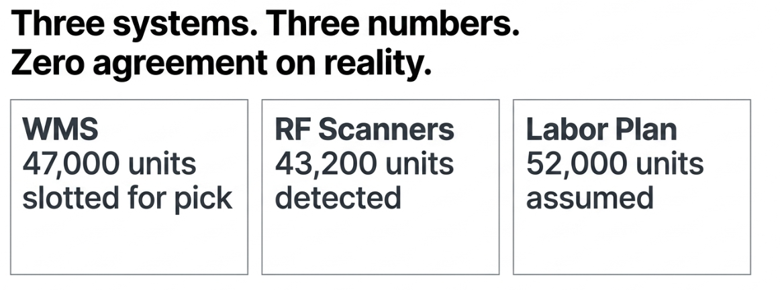
If you have ever stood inside a million-square-foot distribution center at 4 AM watching a wave release go wrong, you know the harsh reality of supply chain data. The warehouse management system (WMS) might say 47,000 units are slotted for pick, while the RF scanners show 43,200, and the labor plan assumes 52,000. It is a scenario with three systems, three numbers, and zero agreement on reality.
Key Takeaways
- Much warehouse data sits behind customer firewalls, meaning vendors have zero access to it.
- The TRUST framework serves as the compliance layer, covering transparency, responsibility, security, and traceability.
- Use a dollar-impact framework so humans approve higher-value AI recommendations.
- Ask AI vendors pointed questions about data provenance, legal basis, and erasure before you buy.
This memory is why Osa Commerce CEO Padhu Raman raises a critical flag every time a supply chain vendor claims their artificial intelligence is "trained on decades of data".
The industry is currently facing what Raman calls the "Federated AI Paradox". There is a massive gap between the marketing narrative of vendors claiming proprietary training data and the operational reality of fragmented, isolated warehouse data. With looming regulatory deadlines like the EU AI Act in August 2026, third-party logistics (3PLs) and retail leaders must bridge the gap between governance and warehouse execution.
Below, we take a deep dive into the realities of supply chain data and the frameworks required for AI to actually work on the warehouse floor.
The Three-Layer Data Reality
When vendors boast about a "decades of data advantage," they are often conflating three distinct layers of data accessibility. Genuine cross-customer federated intelligence is realistically projected for 2028 to 2030, largely because of where enterprise data actually lives today.
DATA LAYER |
ACCESSIBILITY |
OPERATIONAL REALITY |
| Layer 1 | Dark Data | Between 70% and 80% of the installed base remains on-premises. This data includes custom pick-paths and facility-specific labor standards. It sits behind customer firewalls on AS/400 systems managed by local DBAs, meaning vendors have zero access to it. |
| Layer 2 | Isolated Data | Roughly 20% to 30% of systems are converting to private clouds or single-tenant instances. While the infrastructure is cleaner, the data remains logically walled off from vendor training models. |
| Layer 3 | Bounded Data | This is where vendor domain knowledge lives. Their algorithms save clients millions through expertise in code, but they are not training cross-customer AI models on proprietary data lakes. |

Bridging the Gap: The TRUST and SHAPE Frameworks
While many C-suite executives obsess over execution, they are often blind to the friction occurring where governance meets operations. Governance is the base infrastructure that allows execution to scale. To navigate this, leaders should utilize the TRUST and SHAPE frameworks.
TRUST: Governing What the AI Knows
The TRUST framework serves as the compliance layer, addressing mandates like the GDPR and the EU AI Act.
-
Transparency: Operators must be able to trace whether a slotting recommendation comes from their specific data, peer data, or general algorithms to meet EU AI Act interpretability requirements.
-
Responsibility: Clear accountability is required, as data collected from warehouse management cannot be repurposed by vendors for cross-customer training without explicit consent under GDPR.
-
Unified Data: AI cannot naively aggregate data. A grocery distribution center with 50,000 SKUs, cold chain requirements, and FIFO rules generates completely different data patterns than a fashion fulfillment center dealing with 40% returns and seasonal spikes.
-
Security: Federated learning is vulnerable to attacks that can leak competitive intelligence, such as a 3PL competitor inferring your exact picks-per-hour benchmarks. Standard SOC 2 Type II compliance was designed for transactional processing, not AI training.
-
Traceability: Removing a single customer's data from a trained neural network without retraining it entirely remains an unsolved research problem under GDPR Right to Erasure mandates.
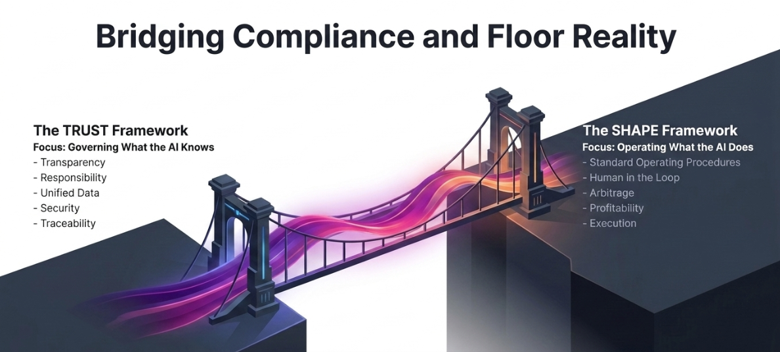
SHAPE: Operating What the AI Does
The SHAPE framework ensures that AI governance functions effectively in the highly variable physical warehouse environment.
-
Standard Operating Procedures (SOPs): AI optimized for a 24/7 mega-DC will create operational chaos if its patterns are applied to a single-shift regional facility. AI must operate within facility-specific workflows.
-
Human in the Loop: Warehouses are too variable for full autonomy due to late trucks, sick workers, and dead RF scanner batteries. A dollar-impact framework is best: AI is autonomous under $2,000, requires human approval up to $20,000, and is completely human-led for impacts above $20,000.
-
Arbitrage and Tradeoffs: AI purely optimized for efficiency often misses real-world nuances. For example, a warehouse manager knows Carrier B is always 45 minutes late and will batch picks differently than the AI suggests.
-
Profitability, Planet, and People (The 3 Ps): Governance must measure total landed cost (Profit), trace carbon footprints for EU CSRD compliance (Planet), and adapt to the actual workforce (People). A people-centric AI knows that one specific worker picks 30% faster or that the night shift has a different rhythm than the day shift.
- Execution and Efficiency: AI recommendations must happen at operational speed. A slotting recommendation that takes four hours to compute is useless if the next wave release is in 20 minutes.

Strategic Checklist for AI Vendor Evaluation
Supply chain leaders in retail and 3PLs must distinguish between "PowerPoint governance" and true architectural readiness. Ask your AI vendors these specific questions:
- Source Attribution: Can the system distinguish between per-instance intelligence and cross-customer patterns?
Legal Basis: What specific GDPR legal basis is used for cross-customer processing? -
Data Provenance: If 70% to 80% of the base is on-premise, how is the AI actually being trained?
-
Adversarial Testing: How do you prevent competitive leakage via gradient inversion attacks?
-
Machine Unlearning: What is the technical mechanism for fulfilling a "right to erasure" request within a trained model?
-
SOP Integration: Does the AI operate within our existing procedures or autonomously recommend changes?
-
Economic Value: Is there a value-sharing mechanism for customers whose high-quality data improves the federated model for others?
- Inference Latency: Does the model run at operational sub-second speed or require round-trip queries?
Failing to address the Federated Paradox is not just an IT issue; it is a financial risk. Organizations that implement these frameworks today will avoid costly mistakes, such as documented $196,000 carrier billing errors caused by unvalidated system configurations. Demand transparency, protect your data, and ensure your AI is ready for the realities of the warehouse floor.