


 Osa Commerce
In this guide
Discover how a modern, unified supply chain stack is transforming logistics, enabling seamless connectivity from manufacturing floors to digital commerce, and delivering the real-time visibility today’s leaders demand.
Key Takeaways
- A full-stack OMS unifies demand, inventory, manufacturing, and fulfillment into one operational reality.
- Manufacturing-aware order management connects demand to production, creating and routing work orders automatically.
- A single intake brings all demand, including EDI, retail POs, and subscriptions, into one order stream.
- Integrating with PLM, QC, WMS, CRM, and RMA systems gives execution teams shared context.
In this guide
There’s a quiet shift happening across commerce, manufacturing, and logistics. It’s not as visible as next-day delivery or new storefronts, but it’s fundamentally reshaping how products move from concept to customer.
For years, the industry operated on a simple, predictable flow: Place an order. Pick from a warehouse. Ship it.
Consumerism has changed—and so have supply chains. Brands no longer sell through a single channel or manage a stable set of SKUs, leading to fractured logistics networks .
Fragmented Networks of Demand, Supply, and Data
The traditional, linear flow of goods is gone. Instead, demand pours in from a diverse array of sources—Shopify, Amazon, Walmart, Target, TikTok, B2B/EDI, physical retail, subscriptions, social commerce, and more—each with unique requirements and data flows.
3PLs Are Now Manufacturing Extensions
Modern third-party logistics providers (3PLs) are evolving beyond traditional warehousing and shipping roles to become integral nodes in manufacturing and fulfillment networks. Today, 3PLs provide a spectrum of critical production and finishing roles, including:
- Value-added services (VAS)
- Assembly and kitting
- Channel-specific packaging
- Personalization for social/engagement commerce
- Custom bundling and subscription prep,
- Returns management
3PLs are no longer passive storage facilities but active participants in product customization, refurbishment, and re-commerce workflows. By executing work orders for finishing, labeling, and SKU transformation on-demand, 3PLs now function as manufacturing-lite extensions. This evolution allows brands to respond to channel-specific requirements, reduce lead times, and increase flexibility, all within the same facility—a necessity in the fast-paced, omnichannel commerce landscape.
From Linear to Network: Why Old OMS/WMS Models Fall Short
Tradition and legacy order management (OMS) and warehouse management systems (WMS) were built for a world where orders and inventory followed predictable, linear workflows: an order is placed, a warehouse fulfills it, and inventory updates follow in batch cycles.
This transactional approach is incompatible with today’s networked reality, where SKUs often represent complex configurations and fulfillment nodes can include factories, 3PLs, co-packers, distribution centers, stores, and micro-fulfillment locations.
Inventory can now exist at the component, batch, lot, or bill-of-materials (BOM) level, and the distinction between manufacturing and commerce is increasingly blurred. The old models are unable to orchestrate this level of complexity, leading to delayed updates, poor visibility, mismatches, and missed optimization opportunities.
A new approach is required—one that treats the supply chain as a dynamic, interconnected network rather than a static pipeline.
The New Architecture: Connecting Demand, Commerce, Manufacturing & Execution
To address these challenges, leading brands and logistics providers are moving toward a four-layer connected architecture that unifies demand, commerce, manufacturing, and execution.
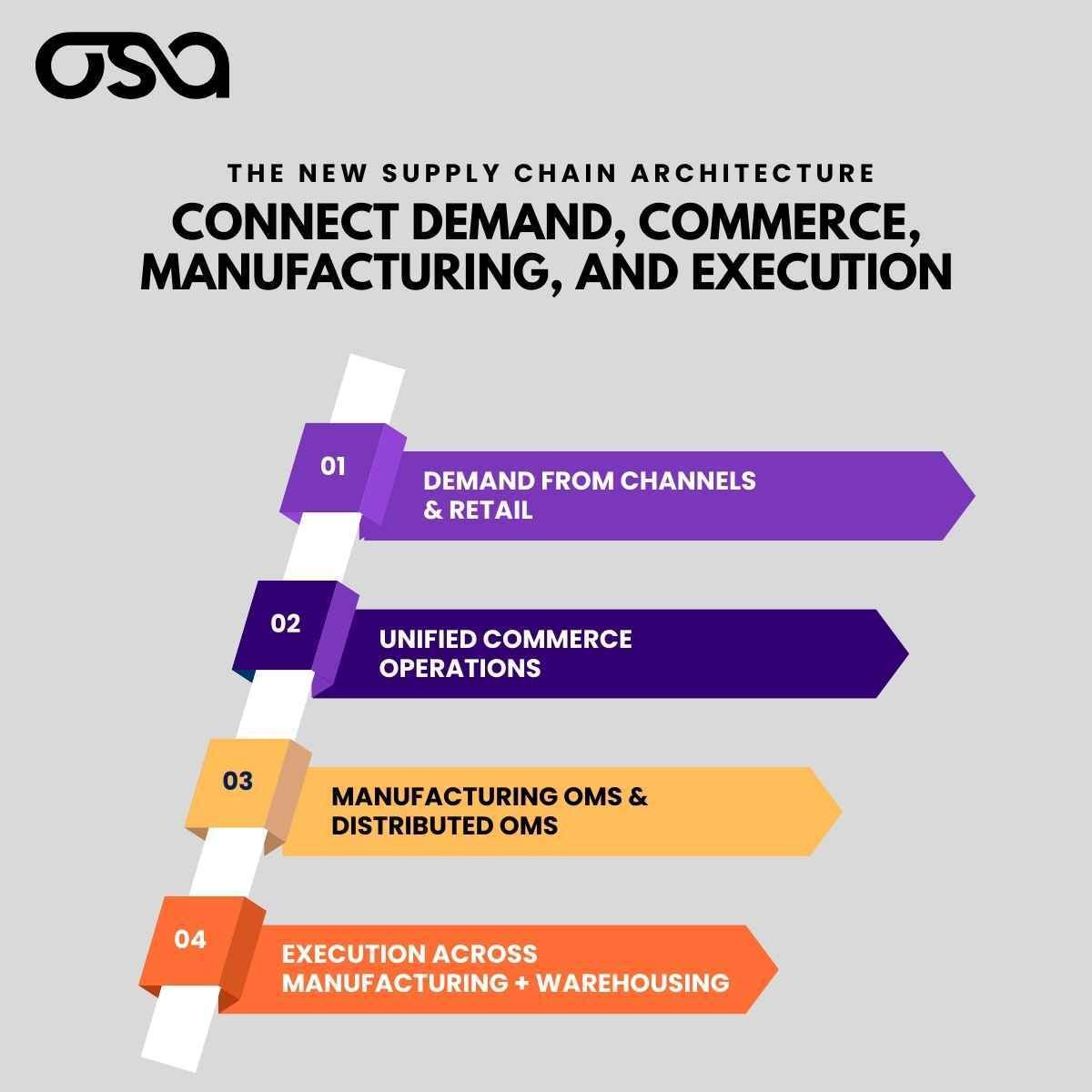
The result is a continuous, real-time flow from customer demand to finished product delivery. This architecture enables collaborative visibility, seamless data exchange, and automated orchestration across all nodes in the supply chain, dramatically improving responsiveness, scalability, and operational efficiency.
Where Osa Commerce Fits In
When you look across a layered architecture, the gap becomes obvious. Most solutions solve only one slice of the journey. An e-commerce OMS helps with routing. A WMS handles pick/pack/ship. A PLM manages product data. A QC tool manages inspections. Transportation systems focus on carrier selection and labels.
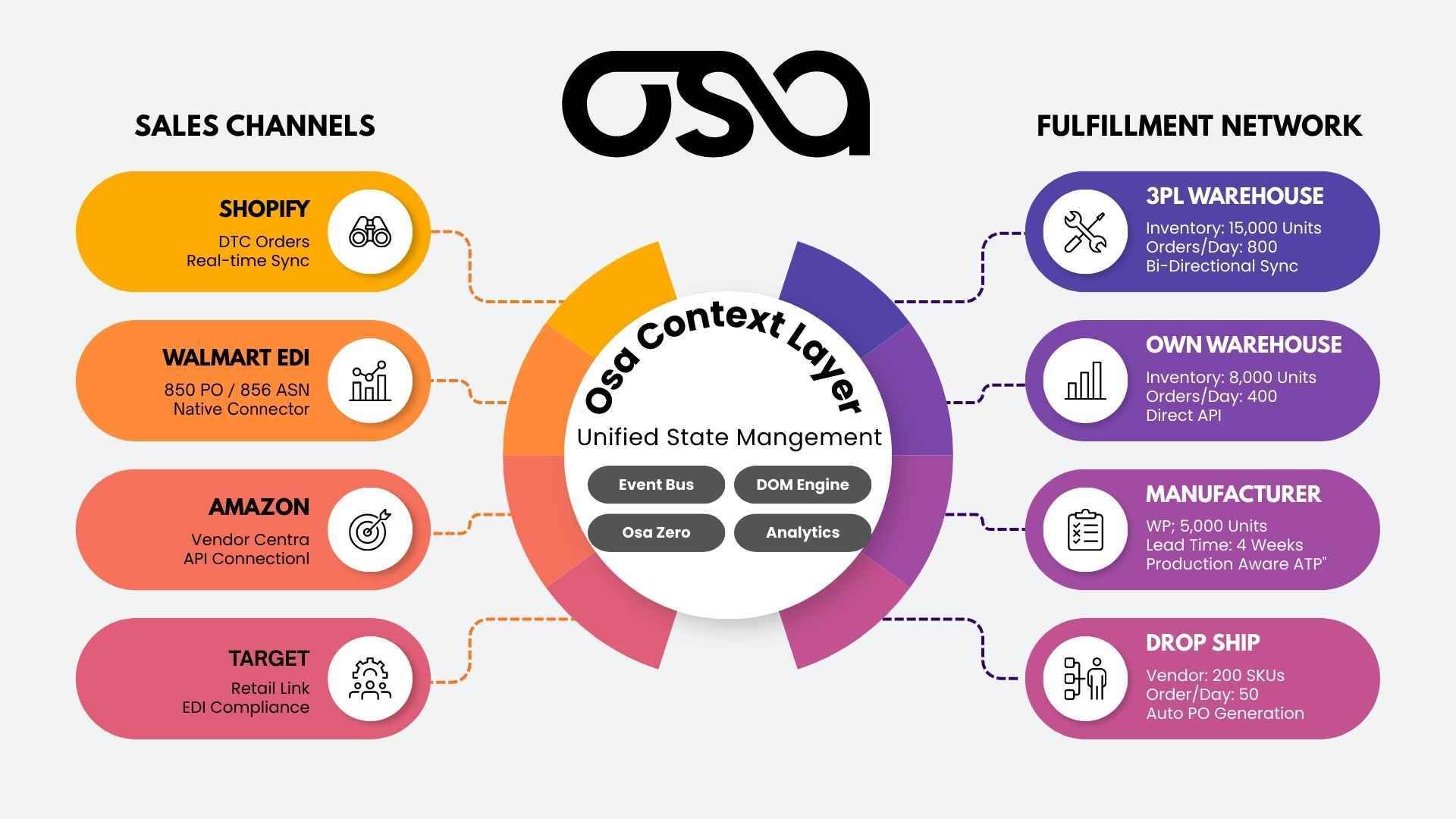
Osa Commerce delivers a full-stack, unified commerce platform with a purpose-built order management system (OMS) designed for the complexities of networked product management. By providing a single intake for all demand sources, Osa Commerce unifies operations across sales channels, fulfillment nodes, and manufacturing partners.
Full-Stack OMS Built for Network Product Management
Manufacturing-aware and able to support complex product configurations, work order execution, and real-time inventory synchronization at every node—factories, warehouses, 3PLs, and beyond, the Osa Platform is built for the world we actually live in. With seamless execution and advanced integration capabilities, we enable brands and logistics providers to orchestrate the entire product lifecycle, from concept to customer, while maintaining data accuracy and operational agility.
Rather than bolting together a dozen tools, Osa provides a Full-Stack OMS that bridges the entire network of commerce, manufacturing, connectivity, communication, and collaboration to the delivery ecosystem.
A Single Intake for All Demand
Whether demand comes from ecommerce, marketplaces, retail POs, B2B, EDI, drops, subscriptions, or custom workflows, Osa brings everything into one unified order stream. Every order is normalized and enriched with product context, so downstream teams understand what’s being requested—not just which SKU was ordered.
One Unified Operational Brain
Instead of managing inventory, availability, and routing logic across disconnected tools, Osa centralizes decision-making into a single operational layer. Brands get real-time visibility across their entire fulfillment and production network and can route orders dynamically based on cost, availability, capacity, and channel-specific rules—keeping operations stable even as demand shifts.
Manufacturing-Aware Order Management
Osa goes beyond traditional OMS capabilities by directly connecting demand to production. It understands BOMs, revisions, components, supplier constraints, and factory capabilities, allowing it to automatically create and route work orders, select the right manufacturer, apply the correct revision, and handle channel-specific requirements like kitting or co-packing. This makes Osa the coordinator of the full product network—not just an order router.
Seamless Execution from Factory to Warehouse
By integrating with PLM, QC, WMS, CRM, and RMA systems, Osa ensures execution teams operate with shared context. Manufacturers know what to build, warehouses know how to package it, and customer teams have real-time visibility into order status, exceptions, and returns. The result is end-to-end alignment between what’s sold, what’s produced, and what’s delivered.
Why Full-Stack OMS Matters Now
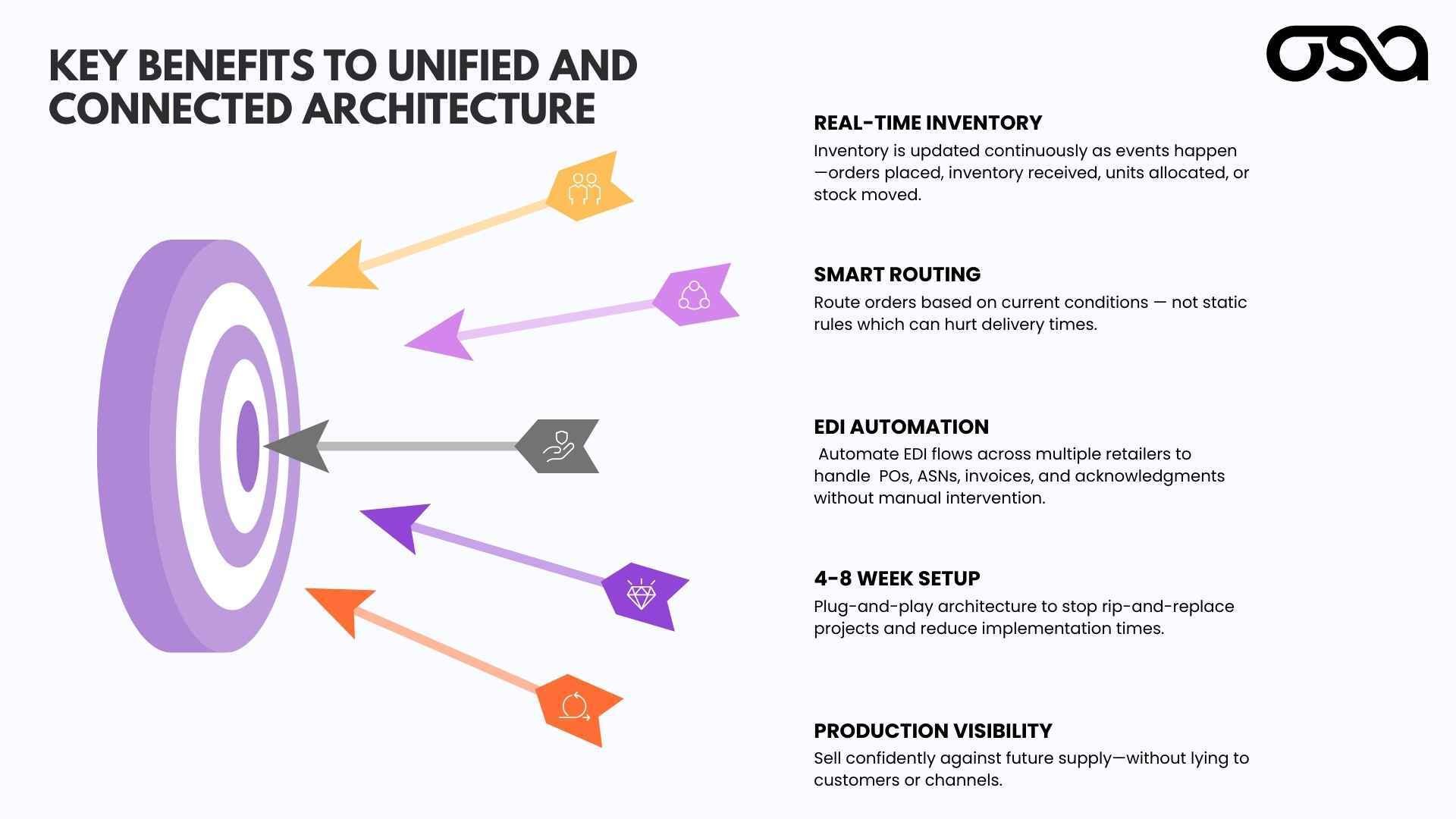
The companies that scale today aren’t the ones with the most tools—they’re the ones with the most connected systems. A Full-Stack OMS unifies demand, inventory, manufacturing, and fulfillment into a single operational reality, replacing fragmented data and reactive workflows with a true source of truth.
With end-to-end connectivity, inventory becomes reliable, Available-to-Promise stays accurate in real time, and every channel operates from the same live picture of what can be sold, built, and fulfilled. Orders route intelligently across factories, 3PLs, warehouses, and stores. Product iterations move faster. Returns and quality signals flow back into operations without friction.
Commerce is no longer just about shipping orders. It’s about orchestrating demand, production, fulfillment, and returns as one continuous system. Disconnected tools can’t do that.
A Full-Stack OMS can.
And that’s exactly what the Osa Unified Commerce Platform is built to deliver.