

 Osa Commerce

Skeptical about the importance of solid architecture for a Warehouse Management System (WMS)?
As a third-party logistics (3PL) provider, your WMS must manage inventory, rules, and billing for dozens or even hundreds of clients under one roof. If that underlying architecture isn't rock-solid and trustworthy, the entire operation can collapse under its own complexity.
Now, think about scaling those operations. How comfortable are you with your current tech stack from a cybersecurity perspective?
The Growing Cybersecurity Supply Chain Challenge
As a 3PL, you sit at a highly vulnerable intersection—you act as a central data hub processing massive volumes of commercial, financial, and customer data for dozens or hundreds of clients simultaneously.
If you are trying to scale by bolting a WMS onto modern carrier networks, merchants, and fourth-party logistics (4PLs), you are essentially building a bank vault with a screen door.
Unless you have a trusted, secure architecture for integrating a complex supply chain ecosystem.
.jpg?width=1200&height=1200&name=CSO%20cyber%20%20Ads%20(1).jpg)
Why Trusted Architecture is Non-Negotiable for 3PLs
For a 3PL, your WMS isn't just an operational tool. It is the solution you are pitching new customers to showcase your ability to serve. If your architecture is weak, the business model fails.
Below is a breakdown of why trusted architecture is non-negotiable for 3PLs.
-
Multi-Tenant Complexity Requires Ironclad Segregation: A 3PL WMS is responsible for multi-client management and requires an architecture that strictly partitions data by customer, sales channel, and warehouse. In addition, every client has different requirements. Client A might need strict First-In-First-Out (FIFO) routing for perishables, while Client B might need serial-number tracking for electronics. A rigid architecture can't handle this; you need a flexible, rule-based foundation.
-
Revenue Leakage and Billing Accuracy: A 3PL's primary revenue stream is charging clients for services rendered (storage, picking, packing, kitting). Activity-based billing must meticulously capture every single touchpoint and transaction in real time, or you lose money. You need a system you can trust to log every action so you can bill accurately without manual, error-prone calculations.
-
Real-Time Visibility and Client Trust: 3PLs essentially act as the fulfillment arm for customers—who expect the same level of visibility as if they owned the warehouse themselves. A trusted architecture enables secure, real-time customer portals. If the system lags, crashes, or shows inaccurate inventory counts, the customer can lose trust in your 3PL and take their business elsewhere.
-
System Integration and Scalability: A 3PL is at the epicenter of a complex product journey—and your WMS doesn't operate in a vacuum. You need seamless connections that must easily integrate via APIs or EDI with multiple client ERPs (like SAP or NetSuite), ecommerce platforms (like Shopify), and carrier networks (like FedEx or UPS). Or, if you're lucky to have a customer go viral on TikTok, your WMS needs cloud-based scalability to handle a massive influx of orders without crashing.
.jpg?width=1200&height=1200&name=CSO%20cyber%20%20Ads%20(2).jpg)
How Poor Cybersecurity Derails 3PL Growth
Failing to implement a secure architecture doesn't just cause IT headaches—it directly affects a 3PL's commercial viability and growth trajectory. Without the ability to safely upgrade or securely integrate into your existing ecosystem, 3PL and 4PL networks are open to risks.
-
Cascading Supply Chain Risks: Visibility often breaks down exactly where third-party systems integrate, allowing cyber breaches to cascade across manufacturing and vendor networks.
-
System Vulnerabilities: Growth requires system integrations, but open access between systems and delayed security patches leave 3PLs highly exposed to cyberattacks.
-
Operational Paralysis: Ransomware is uniquely devastating to logistics. If attackers encrypt the WMS or ERP, the warehouse goes completely dark. Workers cannot see inventory, route orders, or print shipping labels. This leads to immediate SLA failures, shipment delays, and heavy financial penalties.
-
Loss of Client Trust: Reputational damage is the biggest growth killer. Modern D2C brands, enterprise retailers, and marketplaces conduct rigorous vendor risk assessments (often requiring ISO 27001 or SOC 2 compliance). If your architecture cannot pass these audits, you simply will not win their business. A single data breach that exposes client data can lead to immediate contract termination and permanent loss of trust.
-
Regulatory Fines: Exposing personally identifiable information (PII) of end-consumers (names, addresses, payment info) triggers severe regulatory penalties under frameworks like GDPR or CCPA, severely damaging a 3PL's bottom line.
How to Bridge the Cybersecurity Gap with Osa Unified Commerce
The Osa Unified Commerce Platform helps 3PLs bridge the cybersecurity and operational gap between vulnerable legacy systems and modern supply chains through a secure, proactive approach.
Here is how the platform enables this transition:
-
Securing Legacy Integrations: The Osa platform bridges the gap between outdated legacy systems and modern integrated workflows, providing secure, upgrade-safe operations while eliminating IT bottlenecks.
-
Collaborative Visibility: Using the Osa Unified Commerce Platform, 3PLs, retailers, and manufacturers can seamlessly see, share, and secure data across their entire supply chain ecosystem.
-
Proactive Orchestration: Osa shifts 3PL operations from reactive problem-solving to proactive orchestration, allowing businesses to anticipate technical roadblocks and adapt instantly.
-
Enabling Layered Defense: By unifying commerce and operations securely, Osa helps 3PLs implement a rigorous, layered cybersecurity approach that reduces the likelihood of successful attacks and limits potential damage.
Leveraging AI to Monitor Risk
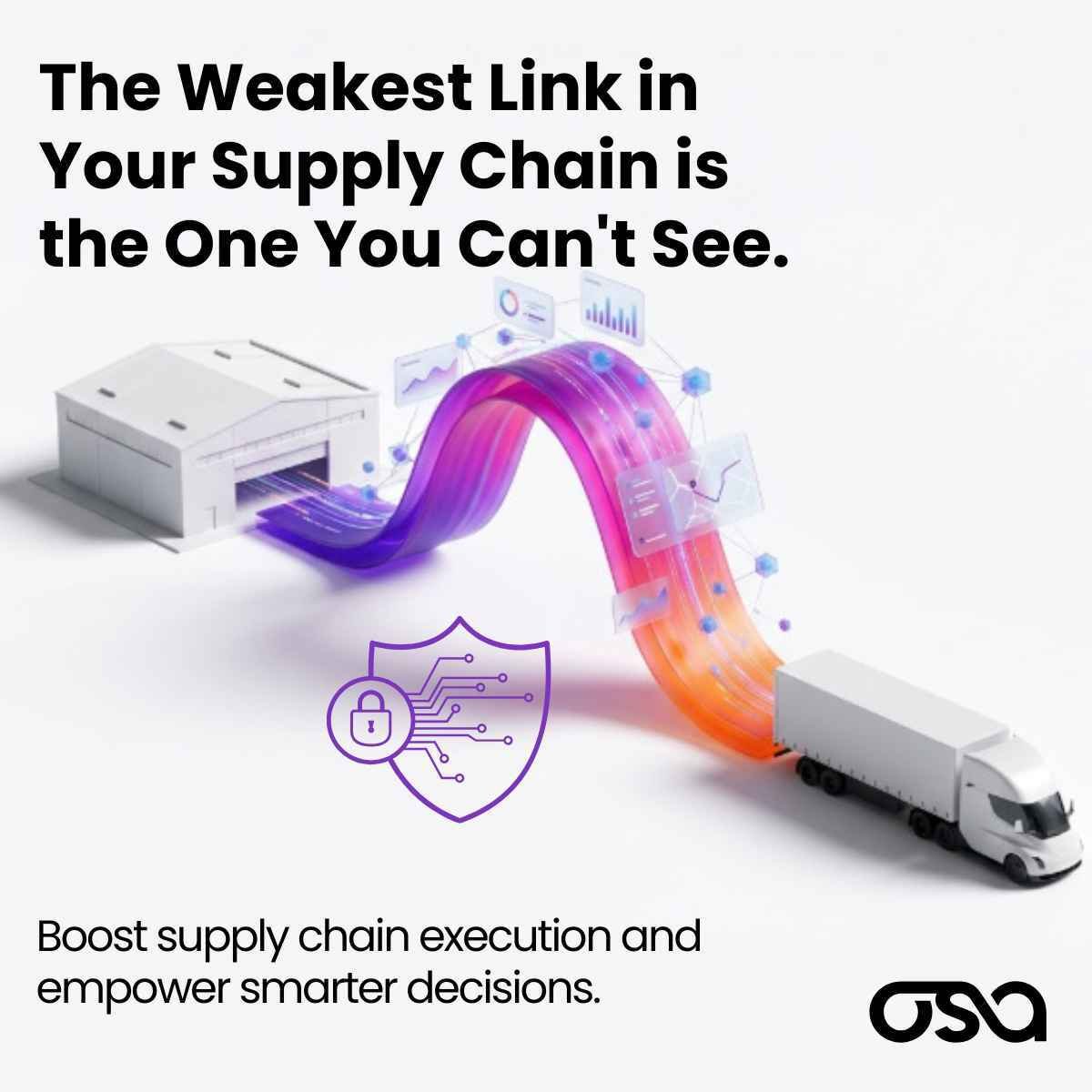
AI allows 3PLs to scale their integrations and client base without linearly scaling their exposure to third-party cyber threats.
In fact, AI fundamentally changes the cybersecurity equation for supply chain operations by enabling continuous monitoring at a scale and speed impossible for human teams.

How 3PLs are Using AI to Monitor Cybersecurity Risks
3PLs sit at the center of a massive, interconnected web of carriers, merchants, software vendors, and 4PLs, they inherit the cybersecurity vulnerabilities of every single partner. Historically, 3PLs managed this risk through static, once-a-year security questionnaires.
Today, forward-thinking 3PLs are deploying Artificial Intelligence to transform third-party risk management from a reactive compliance exercise into a real-time, predictive defense layer.
-
Automated Posture Monitoring: 3PLs use AI-driven platforms to continuously scan the external attack surface of their partners. These tools analyze millions of data points across the internet to assign real-time security scores to carriers and tech vendors.
-
Dynamic Access Control: If a partner's security score suddenly drops (e.g., due to an unpatched vulnerability or credential leak on the dark web), AI-integrated API gateways can automatically throttle or sever that partner's access to the 3PL's network until the issue is resolved.
-
Behavioral Baselines: AI establishes a baseline of "normal" behavior for every integration. It knows exactly what type of data a specific carrier usually requests and at what volume.
-
Instant Flagging: If a merchant's integration suddenly attempts to pull the entire warehouse inventory database at 3:00 AM, the AI instantly recognizes this anomaly. It can block the data exfiltration and isolate the compromised connection in milliseconds—long before a human security analyst even receives an alert.
-
Cross-System Correlation: AI excels at connecting the dots between disparate systems. It can flag when a driver's mobile app logs a location that conflicts with the truck's telematics data, or when a sudden change in shipping routes correlates with unusual login activity on the dispatch portal. This allows 3PLs to catch cyber-physical attacks like cargo hijacking in their early stages.
Conclusion
Ultimately, as supply chain complexity and cybersecurity threats grow, relying on fragmented, legacy systems is no longer viable for 3PLs and retailers. By leveraging a unified platform like Osa Commerce, businesses can bridge the execution gap, secure their integrations, and move from reactive problem-solving to proactive, data-driven orchestration. Investing in upgrade-safe, collaborative technology is the key to scaling operations efficiently and maintaining trust across the entire supply chain ecosystem.