

 Osa Commerce

In this guide
Every day, supply chain teams make hundreds of operational decisions. Yet, a staggering number of those decisions begin with hesitation, not action.
Picture a standard morning operating review: The warehouse management system (WMS) shows one inventory count. The enterprise resource planning (ERP) system reports another. Meanwhile, customer service sees a third order status altogether on the e-commerce platform. Instead of executing fulfillment strategies or optimizing margins, directors and managers spend forty-five minutes reconciling spreadsheets, debating data lineage, and trying to determine which system holds the truth.
Key Takeaways
- Decision latency is a quiet drain on profitability that drives up safety stock and freight costs.
- Moving data between systems is not the same as normalizing it, so teams still reconcile manually.
- Leaders should stop merely connecting systems and start connecting workflows and data.
- Osa Zero acts as a workflow layer that coordinates actions across warehouse, order, billing, and commerce platforms.
In this guide
What Is Decision Latency?
So, how do supply chains manage day-to-day operations to improve cost-efficiency and resilience? Many organizations invest millions in artificial intelligence (AI), advanced robotics, and digital transformation. Yet, as technology stacks expand, operational data becomes increasingly fragmented. Every disconnected system, manual handoff, and conflicting report introduces another checkpoint before a team can act.
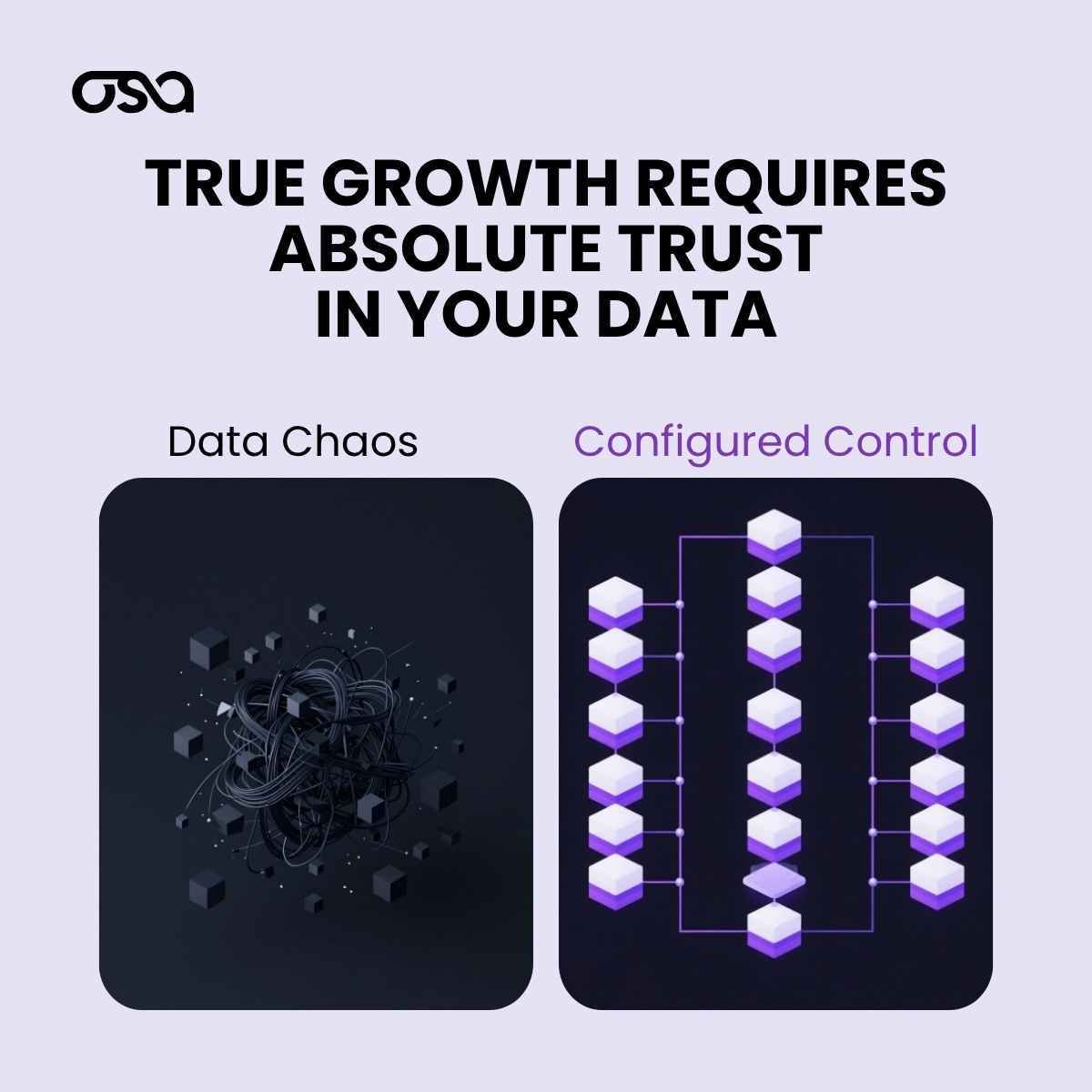
Every lag in real-time data sharing across your supply chain results in productivity downtime, delayed customer replies, and financial losses. In today's fast moving market, the true advantage belongs to organizations that can quickly transform raw data into confident, day-to-day execution.
Deconstructing the Latency Timeline
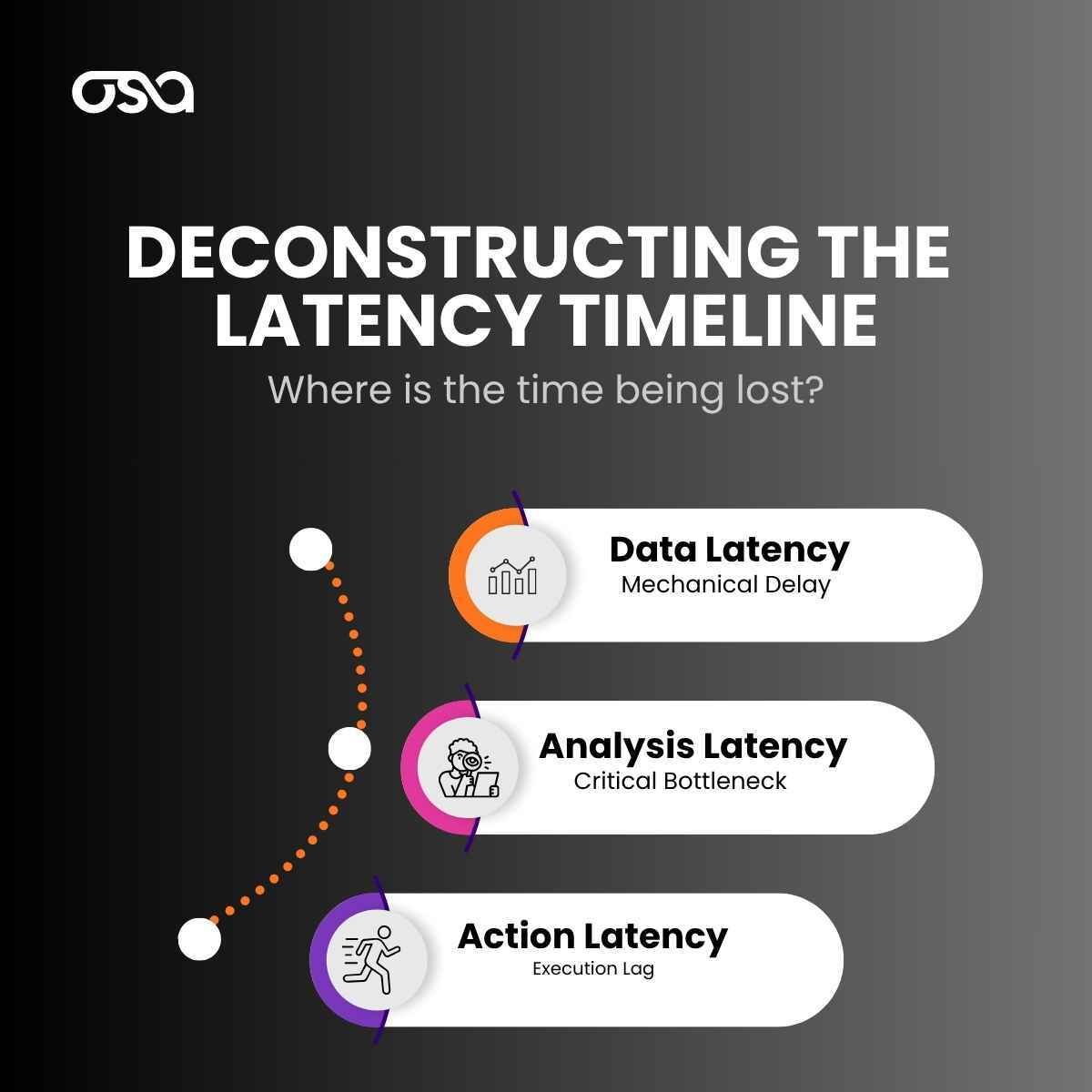
To solve decision latency, we must first understand how this timeline compounds. In any operational pivot, where exactly is the time being lost? It typically happens across three distinct phases:
-
Data Latency (The Mechanical Delay)
This is the mechanical delay between a physical event and the data reflected in a software system. For example, a container clears customs, is updated in the WMS, but the milestone isn't batched into the Enterprise Resource Planning (ERP) system until midnight. -
Analysis Latency (The Critical Bottleneck)
This is where organizational confidence breaks down. Once data is visible, teams freeze because they do not trust it. Managers spend hours cross-referencing portals, calling carriers, or running manual audits to verify accuracy before approving a costly pivot. -
Action Latency (The Execution Lag)
This is the lag between making a decision and executing that directive into live operations. If a team decides to reroute an order, but that change must be manually typed into both an order management system (OMS) and a legacy WMS, time slips away.
The Hidden Costs of Data Hesitation
So, what does data hesitation actually cost the business? Decision latency is a quiet drain on enterprise profitability, forcing organizations to absorb hidden cost buffers across the profit and loss (P&L) statement.
-
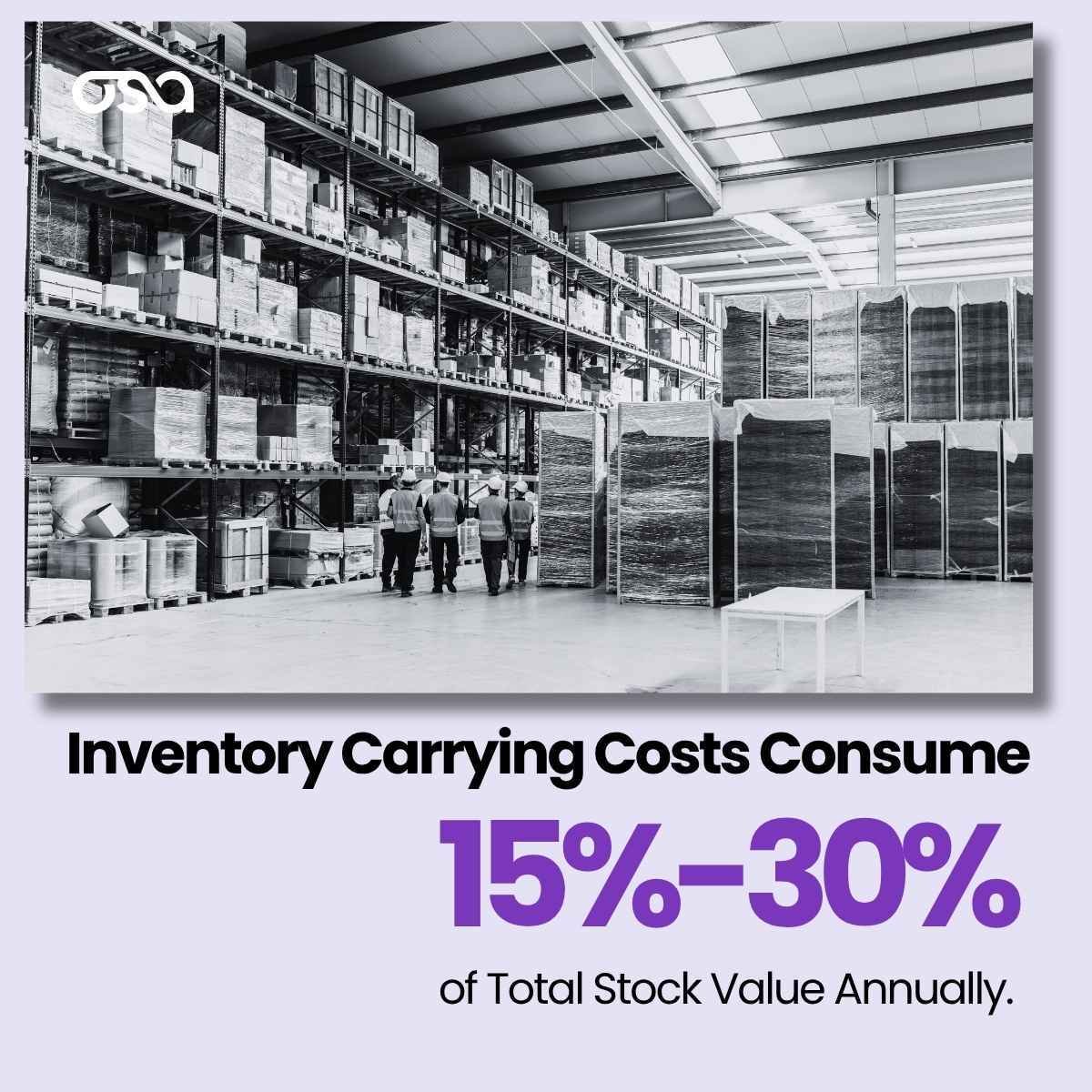
Bloated Safety Stock: Protection against supply chain disruptions is often combatted with bloated safety stock. However, when warehouse counts mismatch digital allocations, procurement over-indexes on safety stock to avoid stockouts, it will unnecessarily tie up critical working capital on physical shelves.
-
Escalated Freight Fees: Fluctuating carrier fees, fuel volatility, port delays, capacity constraints, or driver detention impact operational expenses. When a disruption occurs, 3PLs that act immediately secure standard market freight capacity. An organization suffering from data hesitation can take up to 48 hours to validate a disruption, forcing them to pay premium air-freight rates just to meet delivery windows.
-
Vendor Chargebacks: Major omnichannel retailers have strict rules and requirements for shipping, labeling, and delivery. Should 3PLs or logistics partners deviate from specific vendor routing guides, retailers will penalize suppliers for late or incomplete shipments. When cross-functional hesitation delays fulfillment schedules, it results in thousands of dollars in automated chargebacks.
The Illusion of Connectivity: Why Integrations Fail
To bridge data gaps, 3PLs traditionally rely on point-to-point integrations or custom APIs. But while these pipelines may successfully move data from Point A to Point B, do they actually create a shared understanding or a false sense of operational harmony?
Unfortunately, moving data is not the same as normalizing data.
When you integrate a legacy WMS directly to an e-commerce platform via a standard API, the two systems still run on fundamentally different architectures. Each maintains its own business rules, update cadences, and status definitions.
Worse, as you scale by adding multi-node fulfillment centers, localized 3PL networks, and regional carriers, the integration grid quickly becomes a web of fragile "spaghetti code." If just one system is updated or a single carrier changes its data format, the entire workflow breaks down.
Ultimately, traditional integrations address only data latency, as the data still arrives without context. This leaves humans to manually piece the story together on a spreadsheet—wasting valuable time that erodes margins.
Shift the Paradigm: Connected Systems to Connected Workflows
So, how do forward-thinking supply chain leaders overcome this gridlock? It requires a fundamental architectural shift: leaders must stop merely connecting systems and start connecting workflows and data.
In a traditional system-connected model, information sits passively in individual databases until a human or a batch process moves it. But in a workflow-connected model, data moves dynamically throughout the entire ecosystem in response to real-world triggers.
Rather than treating warehouse operations, order orchestration, billing, and fulfillment as isolated islands, a connected workflow treats them as a single, living organism:
-
Synchronize Marketplaces Instantly: Scan an item on the warehouse floor to trigger immediate, real-time inventory recalculations across every active digital storefront.
-
Prevent Customer Disputes Proactively: Automatically adjust invoicing timelines the moment a carrier records a transit delay, neutralizing billing friction before it happens.
-
Automate Routine Data Validation: Remove human intervention from everyday tracking and focus your team exclusively on high-value operational exceptions.
How Osa Orchestration Eliminates Decision Latency
Many organizations heavily invest in connecting their software applications, but connectivity alone doesn't reduce decision latency. While information may move between solutions, teams still spend valuable time validating reports, switching between applications, and manually coordinating the next step.
Osa Zero Integration Management was built to eliminate that operational gap.
Rather than acting as another isolated integration, Osa Zero serves as a continuous workflow orchestration layer that coordinates actions across warehouse management, order management, billing, fulfillment, and commerce platforms. Instead of building dozens of fragile, point-to-point integrations, Osa Zero Integration Management standardizes how systems exchange information and how AI interacts with operational data, regardless of what system the data originated.
When an operations team needs to check inventory, create an order, initiate a return, or trigger a downstream workflow, Osa Zero translates those requests into system-specific actions behind the scenes.
By directly targeting Analysis Latency, Osa Zero fundamentally transforms how 3PLs and their brand customers interact with data:
-
Single Operational Context: Teams no longer have to navigate multiple clashing applications or manually copy and paste information from one screen to another. The entire workflow executes from a single view.
-
The Unified Data Model: Behind the platform, Osa Zero uses a unified data model that provides a consistent framework for structuring and sharing data across connected systems. This eliminates the "spaghetti code" data discrepancies that cause teams to second-guess their screens.
-
Resilient Automation: Combined with built-in monitoring, automated testing, and error recovery, organizations gain absolute confidence that workflows will execute reliably without human babysitting.
Agility as the Ultimate Metric
Traditional supply chain metrics, like inventory turns and fill rates, measure past outcomes. Decision latency measures your future capacity to adapt.
The most successful supply chain organizations of tomorrow will not win because they collect more data points than their competitors. They will win because they have removed the operational barriers that slow down action. By reducing decision latency, 3PLs can unlock the hidden ROI of existing software investments, protect operating margins, and empower execution at the true speed of the market.
Learn how Osa Commerce can give your 3PL the confidence to act now.